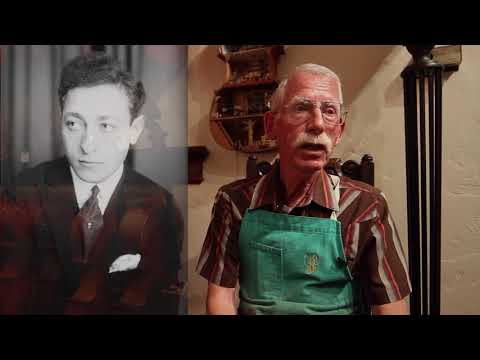
The Violin Maker Who Said No to Jascha Heifetz
When one of the world’s most celebrated violinists walked into Hans Benning’s Los Angeles violin shop in 1974 with a 1740 Guarneri in need of attention, few luthiers would have considered turning him away.
But that is essentially what happened when Jascha Heifetz first met Hans Benning.
Benning, a European-trained violin maker who studied in Mittenwald, Germany, had established a reputation in Los Angeles for his work with fine stringed instruments. He immediately recognized Heifetz when the legendary violinist entered his shop and asked for his help.
There was one complication: Heifetz wanted Benning to come to his home to perform the work. Given the importance of the instrument, Heifetz understandably preferred not to let it out of his sight.
Benning declined.
He explained that his tools, equipment, and workshop were necessary to do the job properly. Working in Heifetz’s home would not allow him to perform the work to the standard he expected of himself.
Heifetz left.
A few days later, however, Heifetz’s assistant returned with the violin and agreed to have Benning work on it in his shop. Heifetz later told Benning that he respected him for standing his ground and maintaining his professional standards.
It was the beginning of a relationship that would last approximately 15 years.
Benning went on to service Heifetz’s instruments, but their relationship extended well beyond the workshop. The two shared meals, spent time together, and even played ping pong. What began as a professional relationship gradually developed into a friendship built on mutual respect.
“Heifetz was a very deep-thinking man,” Benning recalled. “He was a perfectionist, set in his ways. He came to me because he trusted me.”
That trust was especially meaningful given Heifetz’s extraordinary standards, both for himself and for those who worked with his instruments.
“I didn’t want anything from him,” Benning recalled. Heifetz once told him, “You’re more interested in the instrument than me.”
After Heifetz died in 1987, Benning helped assemble the auction of his instruments, bows, and other accessories.
Years later, while attending a memorial concert for Heifetz, Benning heard one of the great violinist’s former instruments played by someone else. He was struck by how different it sounded.
“The same violin, the same music, the same orchestra,” Benning recalled, yet the sound was entirely different.
For Benning, the experience demonstrated something fundamental about great instruments: the instrument itself is only part of the equation.
“It’s the skill of the player to find out what the instrument has and what you can do with it,” he said. “Many people could not play the strings he used to use. He made it sound gorgeous.”
That understanding continues to inform the work of the Benning family today. Benning Violins builds, restores, and maintains fine stringed instruments, drawing on generations of experience with their construction, materials, acoustics, and playing characteristics.
The relationship between Hans Benning and Jascha Heifetz began with an unexpected refusal. What followed was 15 years of trust, friendship, and a shared respect for the instruments at the center of their lives.