Violinmaking: Carving the Violin Mortise

Violinmaking Carving the Violin Mortise

The mortise on a stringed instrument is a lesser-known albeit important part of a violin, viola or cello with a vita function.

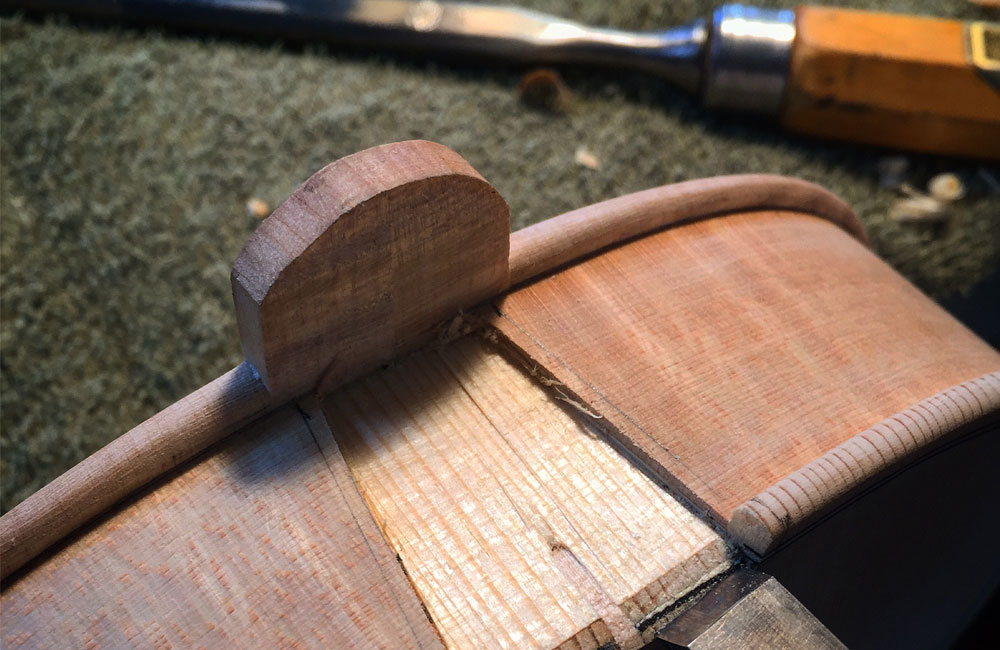
The mortise is a gap in the violin body sized to hold the protruding neck’s matching dimensions so that they can join together. Like many parts of violins, the neck joint is important to the sound of the instrument. Once the body of the violin has been carved out, and the neck is shaped from a piece of wood, usually maple, the next step is carving the mortise and attaching the tenon of the neck. This process completes the basic structure of the instrument.

The first step is sizing the mortise at the top of the violin body. The violin maker makes measurements by holding the root of the neck to the top of the body and tracing it. First, the part of the violin top that goes to the edge needs to be scored with a knife and then cut to the depth of the mortise (approximately 7 mm) and removed with a chisel, to protect the spruce top from splitting during further cutting. Then, the lines on the ribs are gently scored, and the whole rib surface between them is removed with a chisel. Through a gradual process of continued chiseling, the block wood is cut away, and the mortise’s sides and back should be made flat and smooth.

Before gluing, it is important to center the fingerboard on the instrument, eyeing how it lines up with the body of the violin. If unevenness is due to the mortise, the back of the mortise is further scraped for symmetry. The fingerboard should be about 7mm above the neck root and 21mm above the belly, achieving roughly a 6.5-degree angle from the face of the violin. The violinmaker then applies hot animal glue, warming the mortise. A large C-clamp is used to hold the neck in place, and pads to protect the surfaces. It is left to dry overnight.


FINE INSTRUMENT CATALOG

At Benning Violins, we maintain one of the largest selections of fine stringed instruments for sale. Our exceptional collection includes fine violins, fine violas, and fine cellos from renowned old-world masters and contemporary luthiers, including our master violinmaker Eric Benning. Fine violin bows, viola bows, and cello bows crafted by French masters complement our stringed instrument collection.

FINE VIOLINS FOR SALE

We offer an exceptional selection of fine, fully restored violins crafted by old-world masters for examination, trial and purchase. Violins crafted by modern masters round out our collection.

Learn More
FINE VIOLAS FOR SALE

We offer a extensive variety of fine, quality violas crafted from the mid-18th Century to the late 21st Century for examination, trial and purchase. Our violas are fully restored and in-stock.

Learn More
FINE CELLOS FOR SALE

We offer a catalog of fine, master-crafted cellos by old-world and renowned modern makers for examination, trial and purchase. We offer facilities for trial in our studio’s showroom.

Learn More
BENNING INSTRUMENTS FOR SALE

We offer violins, violas and cellos crafted by the Benning family of luthiers, made in the style and tradition of the master Cremonese violinmakers, for examination, audition and purchase.

Learn More
FINE BOWS FOR SALE

We offer an extensive and enviable collection of fine violin, viola and cello bows crafted by the renowned French masters, as well as bows by prominent modern makers, for examination, trial and purchase.

Learn More
BAROQUE INSTRUMENTS FOR SALE

We offer a distinguished selection of fine baroque-era instruments — from Viola da gambas to Viola d’amores — crafted by notable makers, fully restored and available for examination, trial, and purchase.

Learn More
Scroll to Top